Why do we accept without hesitation that the world looks the way it does? Why do we paint on rectangular canvases, why do we write on rectangular paper? Why are almost all floors made up of patterns of rectangles? The answer seems banal: rectangles save material, minimize waste, facilitate transport.
But this “efficiency” is not innocent. It fixes our way of seeing.
It determines that everything is pressed into forms that arise from the logic of production, not from the logic of life. An artist who paints on a rectangular canvas does not only paint on a canvas. He paints on the capitalist rectangle on which art is permitted to appear.
What makes the canvas capitalistic?
At first, nothing. It is white, a neutral beginning on which every color becomes visible. It is made of linen so that pigments adhere well and dry properly. It is useful, but usefulness alone is not yet capitalism. It becomes capitalist only when it is subjected to the logic of scalability: when a once helpful carrier material becomes a standardized product—reproducible, interchangeable, efficiently stackable, globally available.
Objects as we use them in everyday life have a surface level function: the chair supports, the sink drains water, the cabinet stores. This level has become so dominant that we have forgotten that every object could also carry a second dimension, one that is not a means to an end, but pure presence, character, excess. When we look at a piece of furniture and immediately recognize nothing but its purpose, our relationship to it is reduced to use. And when we think only in terms of use we no longer perceive the piece itself, but what it gives us and where it makes our lives easier, richer, better.
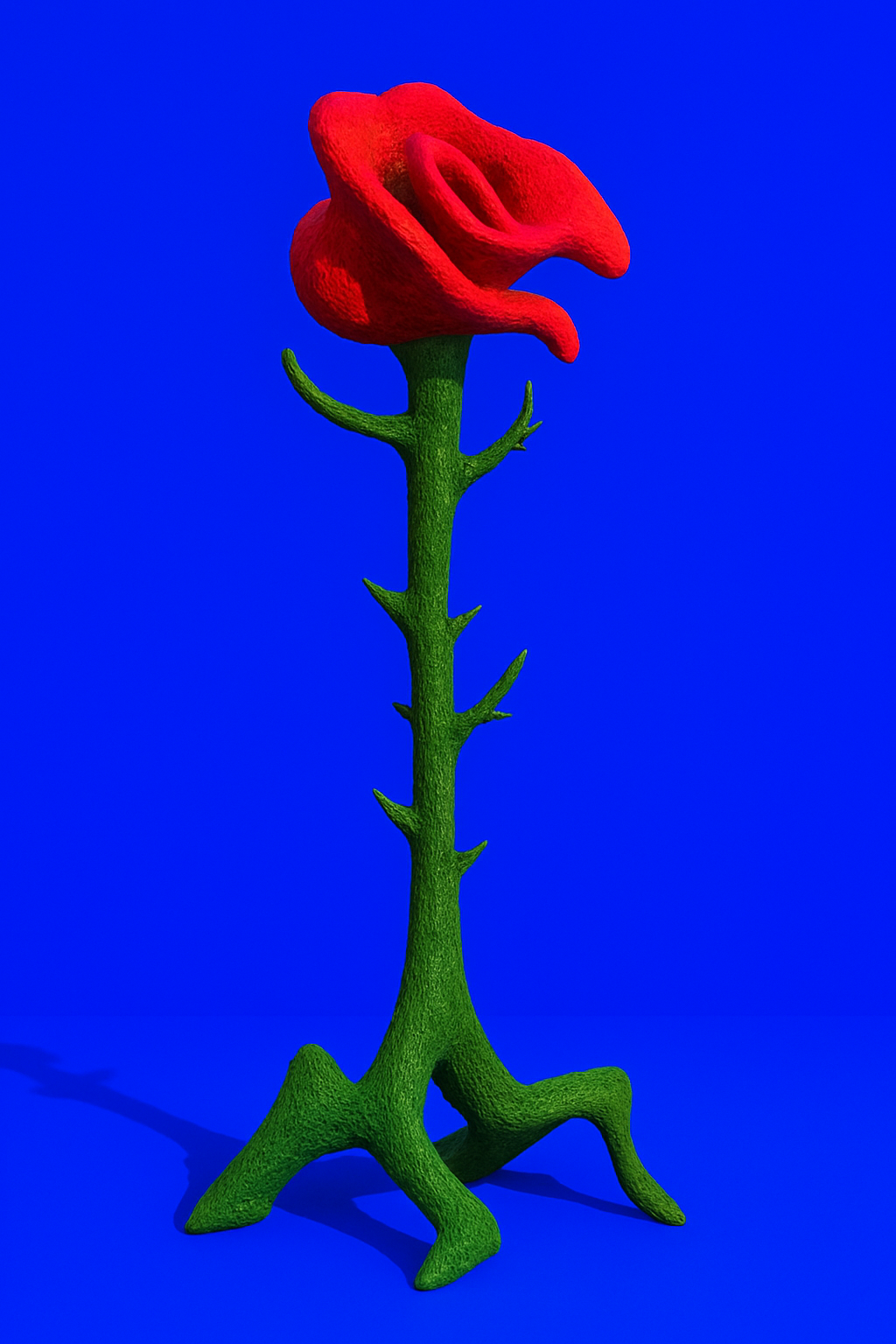
Why do we design coat racks that look like hooks and not like roses whose thorns hold our clothes? Why do we accept cars that look like machine-like blocks and not like animals, birds, beings? Why do we see clothing almost exclusively in terms of its “function”: covering the body, keeping it warm? If the meaning of a pair of pants is exhausted by “covering the ass,” then it becomes clear why so many garments are characterless, generic, optimized for efficiency.
Yet the opposite can also be empty: excess that becomes an end in itself, detached from any necessity, can feel hollow. It can resemble an ornament that never touches us, because it knows no reason to be seen.
Art lies not in one or the other, but in sensing this tension: between necessity and waste, between seriousness and play.
Opposed to purpose stands absurdity: existence without a justifiable purpose, which escapes all functional logic. Absurdity does not mean “nonsense” in a dismissive sense, but the experience that something simply is, without there being a reason for it.
A special case is advertising.
Here, absurdity paradoxically becomes functional. Suddenly an animated cat dances across the screen to sell detergent. A perfume is advertised with the image of an exploding galaxy, a car with a talking frog. These images are exaggerated, absurd and precisely for that reason they fulfill their purpose: to generate attention, to awaken desire, to anchor brands. Advertising is the commercialization of absurdity, in which even the purposeless is pressed into the service of an economic function in order to market products. It shows that even what appears unnecessary can be captured within a logic of use.
But there is also the opposite:
Not only can the absurd become functional; sometimes functionality itself becomes absurd. When an object is so rigorously optimized for efficiency that it suppresses everything playful, sensuous, unpredictable, all that remains is an empty shell of purpose. An object can be constructed so perfectly that it no longer has meaning. A paperclip holder that offers temperature display, clock, calendar, and Bluetooth functionality fulfills countless purposes and they are entirely unnecessary. Function then becomes its own caricature: purposeful to the point of meaninglessness.
These two marginal examples show that intention decisively determines whether a thing is absurd or functional or both. One cannot produce something absurd the moment one intends to achieve something specific with it.
Flowers show us that function and absurdity can exist simultaneously. Their colors do, after all, “fulfill” a function: they attract bees. And the pollination of flowers contributes an essential part to the preservation of the ecosystem in which we too live. But for us as humans, their intense colors, their sensual exaggeration, their fragrant excess are in fact “unnecessary.” It is precisely this abundance, this too-much, that moves us. Perhaps this shows that “function” and “absurdity” never lie in the object itself, but in our gaze. For the bee, the blossom is a tool. For us, it is poetry. This means that the same thing can appear functional or absurd, depending on who is looking.
The world itself is absurd, for why is there an ecosystem at all, why is there existence at all? This cannot be justified. Feelings that arise purely from function never last long. As soon as something works perfectly, we stop noticing it – like a door we open countless times without ever truly seeing it. Function disappears into habit; it makes itself invisible. The superfluous, by contrast, refuses this habituation. It does not explain itself, it does not justify itself, and precisely for that reason it remains perceptible. And maybe that is why it is beautiful every single time to look at a flower: because it needs no reason to be there, and yet it is there.
Freedom toward absurdity is not evenly distributed, for it requires some form of excess. Those who are hungry do not think about how to design a coat rack in the shape of roses. Those who do not know whether they can pay the rent tomorrow have no space to consider whether a car should look like an animal. Absurdity presupposes that basic needs are met. But precisely for that reason it is also a revealing test: it reveals how unevenly our world is arranged. And yet it is strange: never before has there been so much capital globally as today, and yet the unnecessary does not become freer, but rarer. In earlier times, societies transformed their wealth into cathedrals, opera houses, or monumental buildings. That was excess that also touched others. Today, excess is privatized: it hides in luxury apartments, yachts, brands. Capitalism does not make excess disappear; it encloses it. Maybe this is where the true absurdity of our present becomes visible: that we live in the age of the greatest wealth, and yet produce so little shared excess.
© Ema, 2025. All rights reserved .
Leave a Reply